

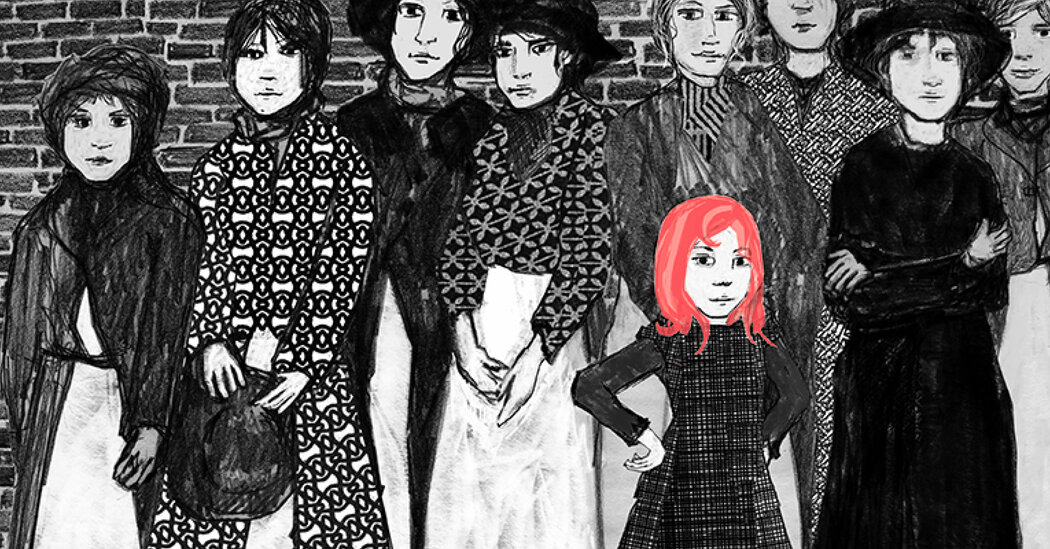
One might think Hans Christian Andersen’s “The Little Match Girl,” an 1845 tear-jerker about a poverty-stricken child who freezes to death one snowy New Year’s Eve, would be a hard sell for today’s kids. But the sad tale and its author get a second chance in two new middle grade novels.
Bridie Sweeney, the narrator of Emma Carroll’s THE LITTLE MATCH GIRL STRIKES BACK (Candlewick, 208 pp., $19.99, ages 8 to 12), has no use for Andersen’s version. Bridie sells matches in Victorian London, and insists the storyteller (she doesn’t name him) got it all wrong.
“I don’t suppose he’d ever met a real match girl in his life,” she says. “If he had, he’d have known we weren’t all pretty things with fair curls and tiny, freezing hands. … We didn’t want people feeling sorry for us; we wanted a fair chance at a decent life, and to one day be able to tell our own stories.”
Bridie knows how to spin a tale, persuading customers that her matches are magic. “You could sell flames to a fireman,” her mother, Mam, declares. Mam toils in an East End factory, dipping matchsticks in phosphorus — which gives workers “phossy jaw,” a painful bone disease. Bridie’s little brother, Fergal, should be in school but makes matchboxes 10 hours a day at the kitchen table.
On New Year’s Eve, 1887, Bridie sets out with hopes of selling enough matches to buy Mam and Fergal a goose for dinner. A near miss with a coach costs her most of her wares and her borrowed slippers (a nod to the source material). Soon she’s no better off than Andersen’s doomed heroine, barefoot and out of luck, striking her last matches to stave off the cold.
But Bridie’s matches turn out to be magic after all. The first strike whisks her away to a world where the rich bask in unearned comfort; the second introduces her to a woman named Annie Besant (a real-life workers’ rights activist), who becomes a sort of practical fairy godmother; the third gives Bridie a glimpse of a better life for her family. The way out involves a strike, all right, but not the kind that requires a match.
Bridie is an energetic, likable narrator, and it’s satisfying to follow her quick-moving adventures.
The gritty East End snaps to life in Lauren Child’s textured illustrations. Modeled on period photographs, they mix gray and black patterns with bursts of telltale red: Bridie’s hair, a candle flame, the bow on a Christmas wreath.
Carroll based her novel on a successful 1888 match factory strike brought to public attention by Besant. “The strike was, and still is, one of the most impressive accounts of a work force standing up for their right to fair treatment,” she writes in an author’s note. “This, I believe, is the ending all match girls deserve.”
It’s the right message not just for 1888 but for 2023, with workers once again taking to the picket lines to demand a fair deal.
For Andie Gladman, the narrator of Cary Fagan’s HANS CHRISTIAN ANDERSEN LIVES NEXT DOOR (Tundra, 160 pp., $16.99, ages 9 to 12), middle school is as toxic as Mam’s match factory. A classmate, Myrtle Klinghoffer, has decided for no reason to make Andie feel like an ugly duckling and turn all the other students against her. Her only friend is the new kid, Newton Newsome, an orange-haired, freckle-faced boy obsessed with Australian fauna, who doesn’t care what Myrtle says.
Andie’s parents stand out as odd, if not ugly, ducks in the small Ontario town of Meaford. They left the city for a simpler life and now raise crickets in the basement to sell as reptile food. Like most of Andie’s classmates, other than Myrtle and Newton, they stay in the background, which gives the story a not-all-there feel. Chelsea O’Byrne’s drawings, delicate and folksy, help bring the characters out of the narrative shadows.
Things turn around for Andie when a tall, thin, sad-looking man moves in next door. The initials on his mailbox, “HCA,” trigger a memory that sends Andie to her bookshelf. Sure enough, the portrait of the author in her neglected copy of “Best Loved Fairy Tales of Hans Christian Andersen” — “a big, thunking disappointment” of a birthday gift — looks a whole lot like her neighbor, even though the guy in the book wears old-fashioned clothes. While far-fetched, the resemblance inspires Andie to give the fairy tales a second chance. Before she knows it, she’s rewriting “The Emperor’s New Clothes” as a poem.
Andie, too, turns out to be a born storyteller, a revelation that changes everything. She scribbles skeptical takes on “The Princess and the Pea,” “The Ugly Duckling,” “The Steadfast Tin Soldier” and, finally, “The Little Match Girl.” Like Bridie, Andie hates that one. “Why couldn’t the author do me a favor/and find some clever way to save her?/Instead, he gave her one last breath/and let the little match girl freeze to death./Mr. Andersen, I tell you true:/For that poor kid, I don’t forgive you.”
HCA, kind enough to play along with Andie’s insistence that he’s that HCA, explains the story like this: “She can remind us that real suffering does exist in the world and we shouldn’t ignore it.” Or, as Andie and Bridie learn, she can inspire us to write happier, more equitable endings for ourselves.
Jennifer Howard is the author of “Clutter: An Untidy History.”

