

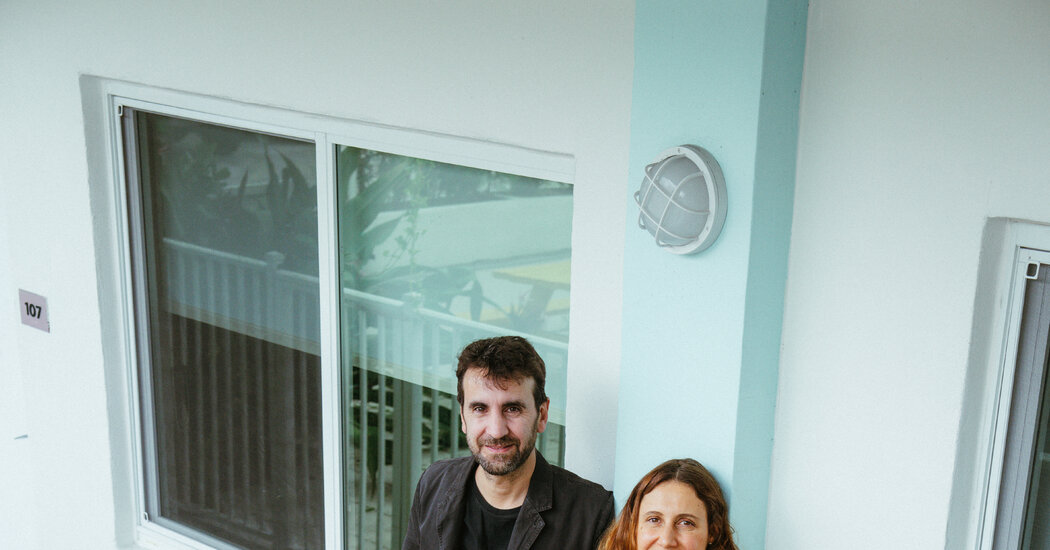
When Sam Klemick was a teenager living in Miami, the neighborhood now known as the Design District was still a place of bars and music clubs. It was where she indulged in happy nights of underage drinking. “Everyone I knew was in a punk band and would play shows there, even though they were so bad,” she recalled.
Now 37 and a furniture designer in Los Angeles, Ms. Klemick is returning to her hometown but not to her old stamping grounds.
The occasion is the annual Miami Art Week, with its centerpiece, Art Basel Miami Beach, and myriad shows, like Design Miami, that attract the rich and famous during the early part of December. But rather than join the throngs at the Miami Beach Convention Center and luxury spaces nearby, she is heading up Biscayne Boulevard to the 1950s-era Selina Gold Dust Motel, where she will exhibit her latest pieces in one of 37 rooms that will display layered and probing designs like hers.
The draw is Alcova. Founded five years ago in Milan, Alcova is an annual exhibition of predominantly small-batch, artistic design, such as Ms. Klemick’s Big Bell chair with chubby, conical legs and her Ribbon side table flaunting a carved wooden bow.
Alcova may be best known for never showing up in the same place twice. In Milan, it has taken over factory buildings that were once used for baking panettone and weaving cashmere and infiltrated the remains of a military hospital, a convent and a slaughterhouse. But now the fair has picked itself up and gone to South Florida.
“We invited ourselves to the party,” said Joseph Grima, who started Alcova with Valentina Ciuffi, the two bearing a similar background of design erudition, curatorial experience and media sophistication that is distinctively European. (Mr. Grima was born in France and raised in Italy and England; Ms. Ciuffi is Italian. They met when he was editing the Italian design magazine Domus and she was on the staff of its competitor, Abitare.)
Alcova’s founders understand that the pleasure of discovering delectable objects is compounded in exotic locations. Far from the standardized booths of exhibition halls, the Selina Gold Dust Motel is a rehabilitated example of Miami modernist architecture in what had once been the red-light district.
“We perceive Miami as one of the few places in the world where Alcova could thrive because there is a very strong established community who essentially come to see what is new in art,” Mr. Grima said.
In Europe, Alcova runs concurrently with the Milan Furniture Fair, the largest event of its kind in the world. The hundreds of thousands of manufacturers and retailers who descend on Milan during its annual design week in April are looking for ideas to produce and sell rather than goods to purchase on the spot. At Miami Art Week, by contrast, the audience is largely art buyers whose primary destination for rare and collectible furniture, until now, has been Design Miami, which conveniently takes place in Miami Beach, alongside Art Basel.
It remains to be seen whether fairgoers will cross Biscayne Bay to visit Alcova’s more conceptual offerings, like an intensely lit room with a stylized rock garden. The project is by Objects of Common Interest, a studio based in Brooklyn and Athens. (“Our big love is public space,” said Eleni Petaloti, one of the founders, adding that the studio’s previous Alcova contribution was an inflatable public fountain. “We’re not the most efficient studio when it comes to the strategy of selling,” she said.)
Alcova was founded to fill a perceived gap. As Milan’s design week became increasingly colonized by luxury brands like Louis Vuitton or Armani Casa, the new event offered a platform to product designers who were just starting out, or who were seasoned but experimental, or who squirmed at the idea of adding objects to an overloaded and resource-challenged planet.
Ms. Klemick, the Miami native, only recently turned to furniture design after years of working in the notoriously wasteful fashion industry. Her latest pieces are made from Douglas fir salvaged from demolition sites around Los Angeles. Dead-stock fabrics were used for the upholstery.
She first showed her pieces at Alcova in 2022, at the abandoned military hospital in Milan. Offered a patch of outdoor space, she found herself in the thick of the action and made friends with other exhibitors. Among them were Maria Teresa Castillo and Santiago Braby Brown, founders of Forma Rosa Studio in Brooklyn, whose tagline is “digitally grown, handcrafted.” The next year, when the couple conceived a group show called “Uncharted” for Alcova Miami, they invited Ms. Klemick to join.
“There’s a huge difference between a trade show format and a historical, in situ context,” Ms. Castillo said about Alcova’s environments. “These are not just products you are trying to sell; there’s a vision, a mood behind them.” (Among other things, Forma Rosa will display polished bronze mirrors inspired by paint drips, which were fabricated in Ms. Castillo’s homeland, Peru.)
Designers who wish to show at Alcova face a high curatorial bar. Ms. Ciuffi said she had received about 300 proposals, many from Americans attracted by the prospect of shipping their work domestically.
Leonard Bessemer, of the Los Angeles studio Objects for Objects, for one, said he proposed a quintessentially American room of sparkly furniture made from the columns of trophies combined with marble slabs evoking their bases. “I’m going to take this nonfunctional, symbolic item and turn it into an actual functional item,” he offered.
Done!
“Alcova is about the creation of a critical mass of interesting people,” Mr. Grima said. “We want it to make it a hub of energy. We think of design as not just objects on display but people coming together to produce interesting work and ideas.”

