

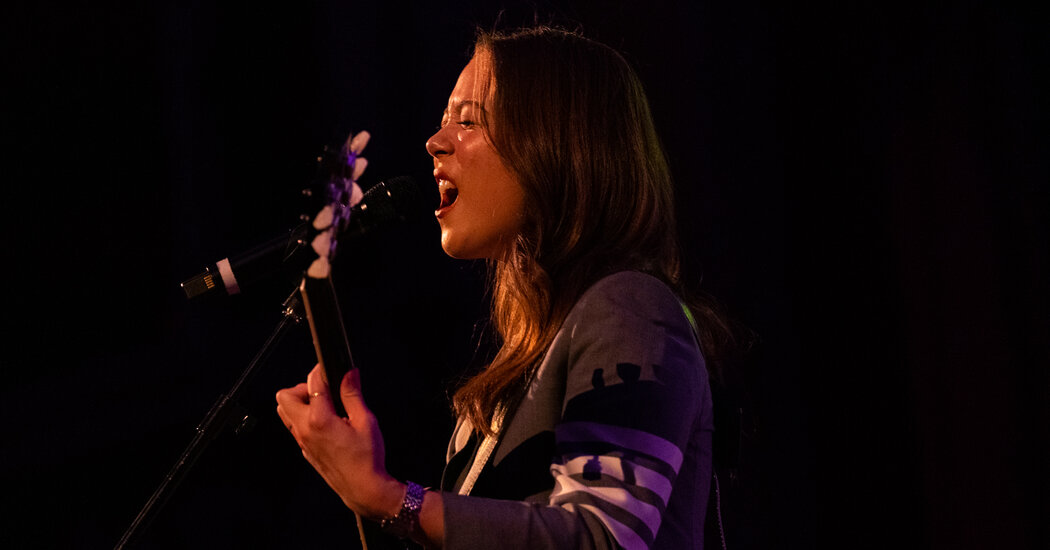
Laufey likes to remind interviewers that she considers herself “old-fashioned,” a term that, on her lips, sounds like it’s splitting the difference between quirky and virtuous. She talks often about her love for Chet Baker and Ella Fitzgerald, and their influence is obvious. But the swooning syrup of her voice has a lot more to do with, say, Patti Page, the grande dame contralto of the 1950s, known for “Tennessee Waltz” and “(How Much Is) That Doggie in the Window?”
None of this is necessarily a problem. But it can be off-putting to hear Laufey (and her now formidable P.R. apparatus) proclaim herself an ambassador of jazz, a genre that she says has been “gate-kept” by an older crowd. “Jazz music was created in the first place as kind of like a deviation from rules, and something that was meant to be free and for everyone,” she told the podcast host Zach Sang recently. “So the fact that it’s become something that feels like it isn’t for everyone is kind of sad, actually. And I think is the death of the genre.”
Equal access, openness, nonjudgmentalism. All important. And yes, it’s possible that her music will bring some listeners to the very much alive and wide-open creative landscape that is jazz. But Laufey — who does not improvise on her instrument, play music with even an ounce of swing rhythm or engage with the chancy collaborative spirit that is the real joy of jazz — is not the music’s ambassador. She is, in fact, making a kind of antiquated radio pop and calling it jazz — precisely the kind of thing that holds the music back, and leaves casual listeners confused about how jazz could possibly still be relevant.
Meanwhile, there is a bumper crop of young, alchemical jazz singers who are smartly engaging with the past, reinventing it in the present, and trying to figure out how its values might translate in our increasingly isolated, digital future. Samara Joy, who won the Grammy for best new artist this year, knows what it means to celebrate the classics while pushing ahead. Esperanza Spalding has been doing it with peerless creativity for over a decade, and she too has caught on with young people by the millions. Melanie Charles’s live show is bold and joyous and well-crafted, but anything but careful or predictable.
The biggest tell at Town Hall was how Laufey played her own tunes: more or less exactly as they appeared on record. It seemed not unrelated to her process on social media: When your followers are dictating what you make next, then you’re trapped in a loop of familiarity. What’s known of you is also what’s expected, and that becomes what you make. To take her music to another level, Laufey may want to take a cue from Mitski — a musician she has covered and for whom she’s expressed admiration — and log off for a while.

