

OPINION:
Anyone who studies history knows that major events do not happen in a vacuum. Every significant moment, especially the most dramatic, takes place in the context of circumstances that preceded them.
The storming of the Bastille in Paris in 1789, one of the most iconic insurrectional moments in Western history, an event that marked the beginning of the downfall of the millennium-old French monarchy, was launched by the fiery words of a young revolutionary who stood on a table in a Paris cafe and incited a crowd.
That incitement, however, would have been of little consequence but for the political, intellectual and social turbulence that was then buffeting France.
Perhaps more familiar to Americans are the battles of Lexington and Concord, the insurrectional acts that started the American War of Independence in 1775. These battles, which pitted American minutemen against British soldiers, resulted from the growing anger and perceived oppression that was simmering by increasingly provocative British actions.
Without the imposition of heavy taxation by a distant Parliament and the ever-increasing pressures being placed on the American colonists, the first shots of the American Revolution would not have been fired.
This kind of analysis applies to every major historical event, be it the fall of the Roman Empire, the Russian Revolution, the American Civil War, or World Wars I and II. All important historical moments can be properly understood only in their respective contexts.
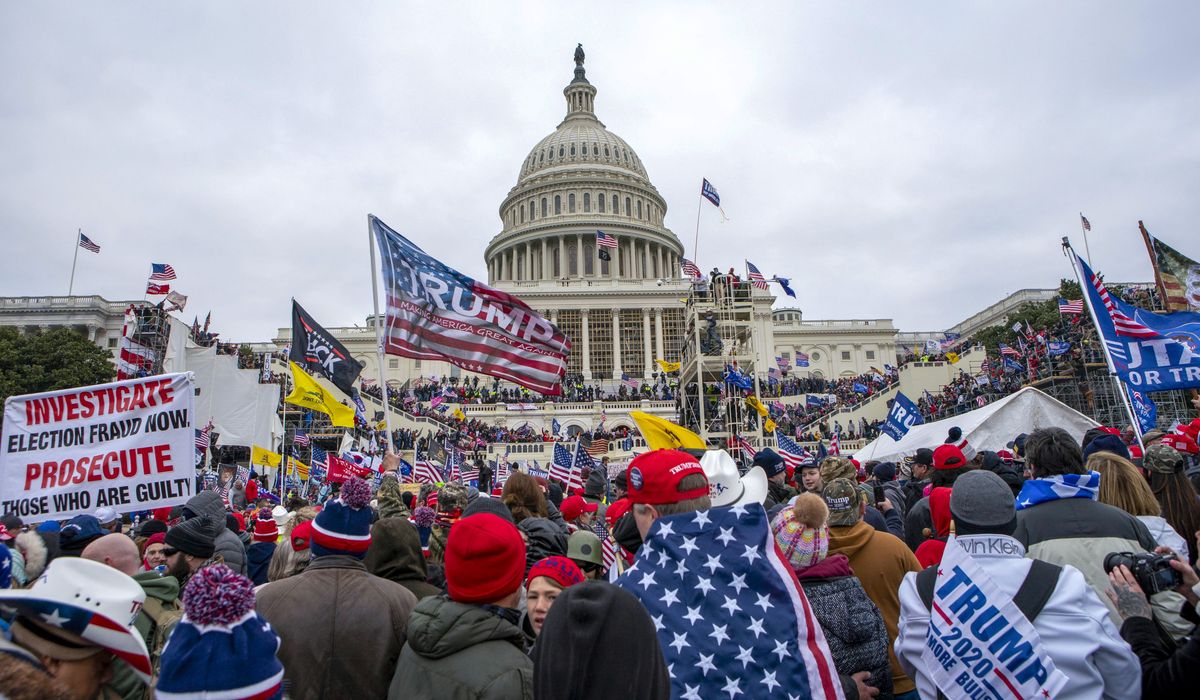
Today, the current event-obsession is with the Jan. 6, 2021, riot at the U.S. Capitol. Listening to the mainstream media, it would appear as though a few words from then-President Donald Trump fomented the events of that day.
A more reasonable analysis of the riot of Jan. 6 would place that event in the context of the months that preceded it. In the months immediately following the killing of George Floyd by a police officer, much of the nation was buffeted by violence, violence that was often characterized by the mainstream media as “mostly peaceful.”
The images of the violence rocking our cities appeared on news programs in the summer and fall of 2020. Yet there seemed few consequences for those who engaged in it. As a result, some people were lulled into believing that if the cause is just, then the means used must be equally just, even if violence is involved.
Those months of turmoil took place in the midst of a partisan and contentious presidential campaign in which Mr. Trump was the featured actor and then-candidate Joe Biden appearing to be a supporting player.
Logically, if great events in history must be viewed contextually, then the actions of individuals must also be considered in their own context. Thus, Mr. Trump had to view his reelection run as he lived it. What Mr. Trump experienced of necessity contributed to his distorted perspective on the election. Criss-crossing the nation at a frenetic pace, Mr. Trump held rally after rally involving thousands of enthusiastic, even adoring, followers.
The fervor of his followers must have led Mr. Trump to believe that he was invincible. The enthusiasm at his rallies was distinctly different from the lethargy and immobility of the Biden campaign. Mr. Biden eschewed rallies, choosing to remain in his basement, where he gave occasional interviews that often veered into the ridiculous. One need only remember his foolish observation to a Black interviewer that any Black person who did not vote for him “ain’t Black.”
The energy and vigor of the Trump campaign stood in stark contrast to the passivity and isolation of the Biden campaign. Campaign coverage by the mainstream media, which focused heavily on Mr. Trump, albeit with a very negative tilt, made it seem as though the election contest were really just a one-person race. To Mr. Trump, this was confirmation that he was the inevitable election winner.
Today, in the wake of the unprecedented indictments of the former president, it is easy to forget the violent context of the months leading to Jan. 6 and the momentum of the 2020 election campaign that suggested to Mr. Trump, if not to others, that his victory was a foregone conclusion. Yet that context provides the best means of understanding this deeply regrettable chapter in our history.
Violence begets violence. Acceptance of violence normalizes violence and makes it seem acceptable. The summer of 2020 made many Americans believe that, to be heard, only physical turmoil could accomplish that goal. Even more significant was the perception that there were no consequences to violence in the public square.
And if Mr. Trump’s injudicious use of words may have helped to motivate his followers to emulate some Black Lives Matter demonstrators, it is due to his perception that only because of fraud was he not the inevitable winner of the presidential election.
Viewed in this contemporary historical context, neither Mr. Trump’s refusal to accept the election results nor the attack on the Capitol should be viewed as an aberration. Without justifying either, it is nonetheless important to note that they were both byproducts of events that preceded them and which were generated by various social forces, including our media and tolerant municipal authorities.
History reaps what history has sown. Not even the current persecution of Donald Trump can change that.
• Gerard Leval is a partner in the Washington office of a national law firm. His book, “Lobbying for Equality: Jacques Godard and the Struggle for Jewish Civil Rights During the French Revolution,” was published by HUC Press last year.

