

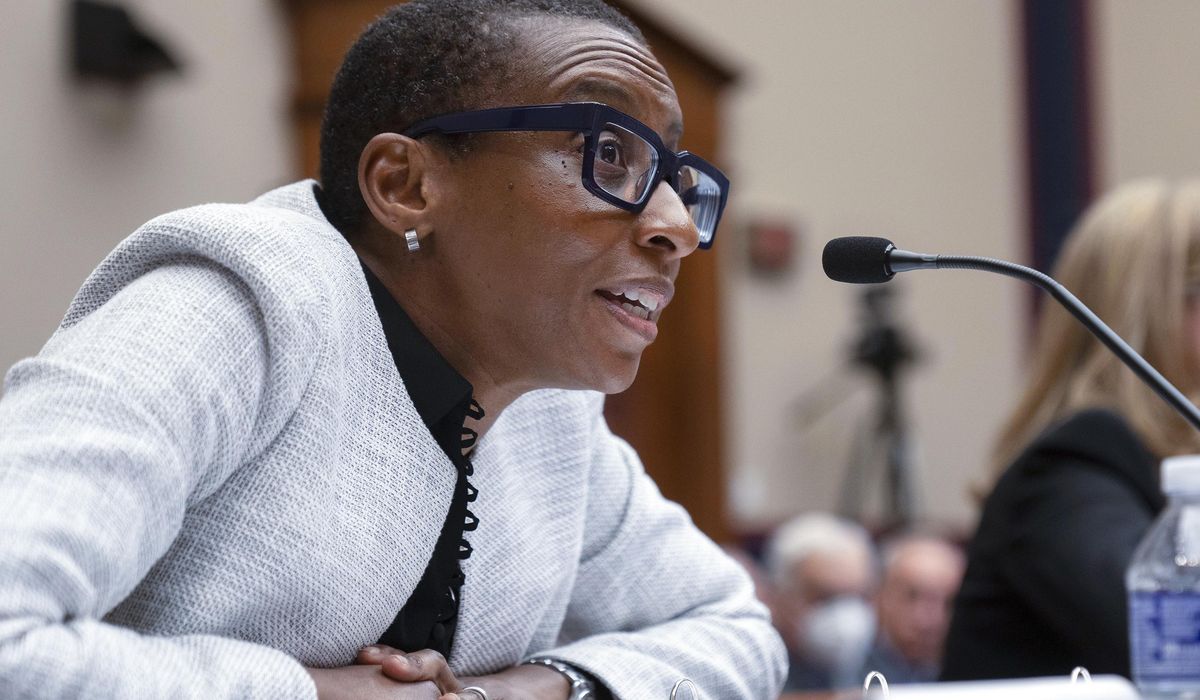
Harvard President Claudine Gay survived an antisemitism uproar only to be engulfed by a plagiarism scandal that threatens her brief term in the top job, as well as the reputation of the nation’s oldest university.
Calls for Ms. Gay to resign are piling up as the plagiarism claims snowball. She now stands accused of 41 instances of failing to give proper credit in seven articles over a 30-year period, according to the latest tally by Manhattan Institute Senior Fellow Christopher Rufo, who aired the first public charges two weeks ago.
The seven published writings in question represent more than half of the 11 articles listed on her resume, a conspicuously thin record of scholarship for the president of what many consider the nation’s most prestigious university.
“This is a scandal of epic proportions for the world of higher education and for the Ivy League,” Peter Wood, president of the National Association of Scholars, told The Washington Times.
He said the fact Ms. Gay reached “sort of the summit of Mount Everest, the highest position an American academic could possibly attain—and she got there with a very meager publication record.”
“And then that record itself turns out to be largely bogus,” he said.
The Harvard Corporation reacted to the growing furor late Wednesday by telling the Crimson, the student newspaper, that Ms. Gay would request three corrections to her 1997 Ph.D. thesis, based on the findings of a subcommittee formed by the board to consider the allegations.
Notably, Harvard didn’t use the word “plagiarism,” saying the subcommittee found “duplicative language without appropriate attribution.”
Ms. Gay previously submitted four corrections to two of her articles after an “independent review” found “a few instances of inadequate citation,” although Harvard said the probe that concluded on Dec. 9 “found no violation of Harvard’s standards for research misconduct.”
If members of the Harvard brain trust think that seven corrections are going to resolve the matter, they haven’t been paying attention to Carol Swain.
Ms. Swain, a conservative political scientist and legal scholar, became a central figure in the scandal following charges that Ms. Gay paraphrased nearly verbatim two passages of Ms. Swain’s 1993 book, “Black Faces, Black Interests” (Harvard University Press).
Ms. Swain, a distinguished senior fellow at the Institute for Faith and Culture, offered Thursday some “free unsolicited advice” for Harvard, a list that included “Fire Claudine Gay posthaste.”
“She is a documented serial plagiarist,” Ms. Swain said on “The Clay Travis & Buck Sexton Show.” “That cannot be denied, and Harvard University can’t decide unilaterally that they’re going to change the definition of plagiarism just to protect its first-ever Black president.”
I have some free unsolicited advice for Harvard University.
1. Stop listening to the apologists for plagiarism.
2. Fire Claudine Gay posthaste. She can be relieved of duties until the terms are negotiated.
3. Stop listening to the racist mob of whites and blacks who cry racism… pic.twitter.com/TggW9QzTkB
— Dr. Carol M. Swain (@carolmswain) December 21, 2023
Others calling Thursday for Ms. Gay to step down include Sen. Tom Cotton, Arkansas Republican, a Harvard alum who said the resignations shouldn’t stop there.
“Of course Harvard’s president should resign in disgrace for tolerating antisemitism and her rampant plagiarism,” he said on X. “But so should every member of Harvard’s board who covered up for her and allowed this to happen.”
Ms. Gay, who assumed the Harvard presidency in July, defended her academic integrity in a Dec. 12 statement, saying her scholarship “adheres to the highest academic standards,” but she has not commented on the issue since.
Meanwhile, the plagiarism issue jumped this week from the conservative press to the left-tilting legacy media, including the Boston Globe, which asked in a staff editorial, “Did Claudine Gay plagiarize or not? Harvard should be clear.”
The New York Times called the allegations against Ms. Gay an “embarrassing development” for Harvard, while CNN said that the latest corrections fail to address “even clearer examples of plagiarism from earlier in her academic history.”
A full-blown plagiarism uproar was the last thing Harvard needed in the wake of the furor over campus antisemitism following the Oct. 7 Hamas attack on Israelis.
The outcry over the administration’s initial tepid response culminated in a disastrous Dec. 5 House hearing at which Ms. Gay and other university presidents said that whether calling for “genocide of Jews” violates conduct codes would depend on the context.
Those comments prompted the resignations of University of Pennsylvania President Liz Magill and Penn Board of Trustees Chairman Scott Bok, but the Harvard Corporation refused to force out Ms. Gay, billing her as “the right leader to help our community heal.”
Meanwhile, the university’s prestige and pocketbook have suffered. Applications for early admissions fell this year by 17%, while arch-rival Yale University saw a 1.4% increase, according to figures released earlier this week.
The donor revolt also shows no signs of abating. Billionaire Len Blavatnik, a Harvard Business School grad whose family foundation has donated an estimated $270 million to Harvard, has paused his financial support, Bloomberg reported Thursday.
Harvard still boasts the nation’s largest university endowment at $51 billion.
Rep. Virginia Foxx, North Carolina Republican who chairs the House Education and the Workforce Committee, expanded the probe into antisemitism at Harvard to include the plagiarism charges, expressing concerns that Ms. Gay may have gotten away with conduct for which students would have been suspended or expelled.
In Ms. Gay’s corner are large swaths of the Harvard faculty. More than 600 faculty members signed a petition after the House hearing, urging the board to “resist political pressures that are at odds with Harvard’s commitment to academic freedom, including calls for the removal of President Claudine Gay.”
Steven Levitsky, a Harvard government professor, told The New York Times that the examples of alleged plagiarism appear to be “mild sloppiness,” adding that quantitative scholars like Ms. Gay are less concerned with “their literature reviews.”
Taking issue with his view was Rep. Elise Stefanik, New York Republican and a Harvard grad.
“On the world stage, @Harvard continues to shred any remaining semblance of academic integrity,” she said on X.

