

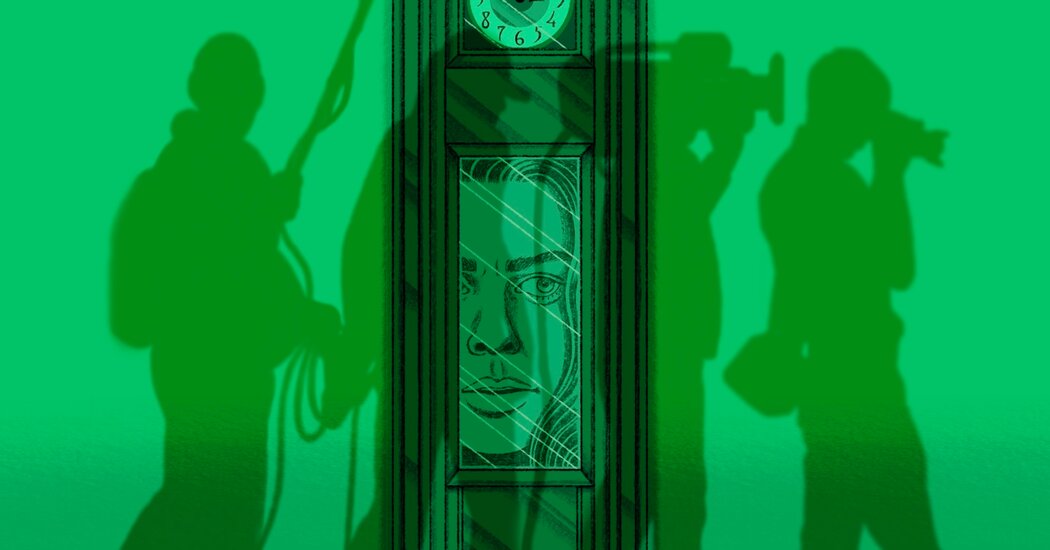
THE INVISIBLE WORLD, by Nora Fussner
Ghost stories often start with a bump in the night, a figure in a mirror, a disembodied voice whispering from the void. But Nora Fussner’s thought-provoking debut novel, “The Invisible World,” opens with a different kind of bang: the slam of a van door as the crew of a struggling supernatural reality show pulls up to a farmhouse to shoot their newest episode.
The team behind “Searching for … the Invisible World” are a bunch of big-city skeptics brimming with their assumed superiority over the small-town families whose lives they package each week into neat 42-minute segments. They’ve done this so many times that when they arrive at the farmhouse, they present the owners, Ryan and Eve Hawthorne, with a helpful manual titled “What to Expect When You’re Expecting a Reality Show to Descend on Your Home.” The crew is utterly unfazed by any of the poltergeists that the show purports to expose because they know the dirty little secret of reality television: Every episode is scripted before a single camera starts to roll.
The book itself is structured like a shooting schedule, with transcripts of interviews sprinkled throughout the narrative. It does not take long before things veer off script.
Fussner populates her novel with a broad cast of colorful characters, so many it can be hard to keep track of everyone. But at its heart are three women: Sandra, the show’s overworked producer; Caitlin, an enthusiastic teenage ghost hunter; and Eve, an artist haunted by a childhood experience she’s never been able to explain. The aftershocks of that experience have shaped her life ever since. On her second date with Ryan, when she realizes she wants to spend her life with him, she decides to trust him with her story — one she has never shared with another soul.
But Ryan is a skeptic, chalking Eve’s tale up to the haziness of a child’s memory or her brain working to suppress some horrible trauma she doesn’t want to see. He is similarly dubious of her present experiences in their home, where Eve confronts picture frames that won’t stay on the walls, electrical outlets that spark and light her easel on fire and a vision in the bathroom mirror of a bedraggled woman standing behind her.
These persistent denials from her partner erode Eve’s ability to trust her own senses. “She hadn’t understood the weight of Ryan’s power,” Fussner writes, “the power to confirm or deny her reality.”
Eve hopes that the television show will finally allow her to tell her story on her own terms. But rather than receiving support from the “Searching For …” crew, she finds herself once again being pressured into disbelieving her own experiences in order to fit a narrative somebody else finds tidier, more comfortable. It’s a position that any woman who has ever been dismissed as silly, paranoid or — most insidious of all — hysterical will find familiar.
As Eve grows more frustrated, the otherworldly phenomena grow more and more undeniable. Crew members start disappearing, others witness the apparitions for themselves, and even skeptics like Ryan and Sandra find it hard to rationalize away what’s happening.
But Fussner’s haunted house turns out to be a bit of a Trojan horse, carrying deeper questions about how narratives are controlled, and how much the “real” version of events depends on who is doing the framing. Yes, there are plenty of thrills, but readers are more likely to be kept up at night because they can’t put the story down than because of any truly terrifying scares. More than anything, “The Invisible World” invites readers to consider a more human proposition: What happens when a woman is dismissed — and what power may be unleashed when she is finally believed?
THE INVISIBLE WORLD | By Nora Fussner | 307 pp. | Vintage Books | Paperback | $17

