

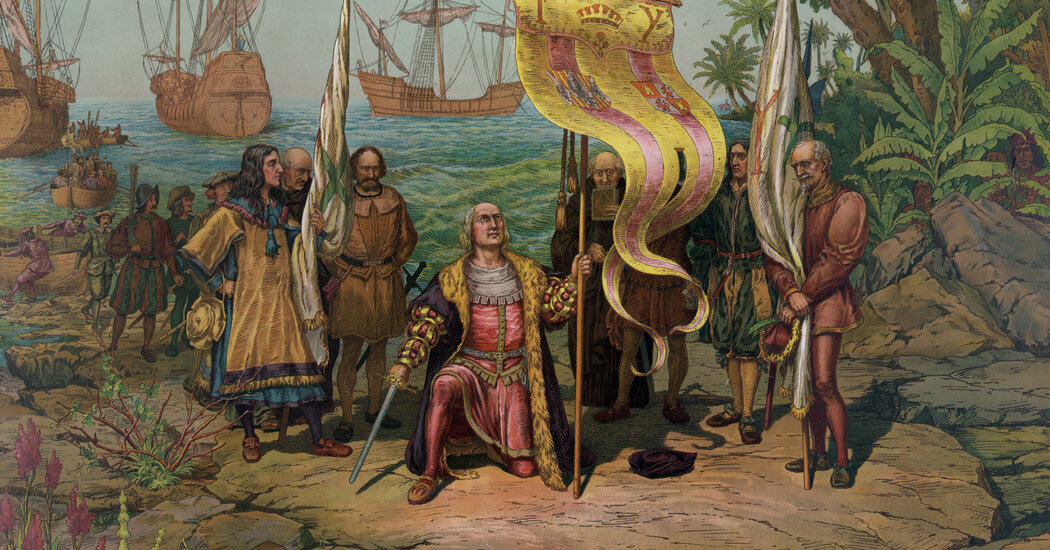
One of Jones’s boldest suggestions is to locate the “roots” of American racism not in 1619 or other defining moments in the history of American slavery, but much further back, within religious practices developed in the aftermath of the Columbian Encounter. In 1493, Pope Alexander VI issued an edict praising Columbus for extending European dominion to lands “not previously possessed by any Christian owner.” The declaration was part of what became known as the “Doctrine of Discovery,” an enduring if amorphously defined set of proclamations and legalistic rituals created in the late 15th century to validate European appropriation of the territories of the Western Hemisphere and justify colonization — including, in 1541, in what is now Mississippi, by the Spanish explorer Hernando De Soto, who claimed much of the South.
The Doctrine of Discovery has legitimated the expropriation of Native American lands for more than 500 years. Yet, as Jones points out, few know much about this history or its ongoing influence. In 2005, the Supreme Court invoked the doctrine in its ruling in City of Sherrill v. Oneida Indian Nation of N.Y., denying a claim by the Oneida Nation that it should not have to pay taxes on land that once belonged to it as part of a sovereign reservation but that had been sold to the state in 1805 — in violation of a federal treaty — and then, in the late 1990s, reacquired. Writing the majority opinion (and citing the doctrine in a footnote), Justice Ruth Bader Ginsburg argued that the tribe could not “unilaterally revive its ancient sovereignty, in whole or in part” since it “long ago relinquished reins of government and cannot regain them through open-market purchases from current titleholders.” The decision was criticized by scholars and Indigenous activists for enlisting the doctrine in a legal argument favoring the land’s colonizer over its original inhabitants.
For many minority communities, history remains simultaneously a sword to wield and a shield to seek out for protection, and myths of cultural superiority continue to impair racial progress. In June, the Supreme Court decided the case of Haaland v. Brackeen, which challenged the 1978 Indian Child Welfare Act, giving preference to Native American families in cases involving the placement of a Native American child. The court upheld the law in a 7-2 ruling.
But in a dissenting opinion, Justice Samuel Alito objected to the act’s prioritizing of tribal affiliation, arguing that it required “a state to abandon the carefully considered judicial procedures and standards it has established to provide for a child’s welfare and instead apply a scheme devised by Congress that focuses not solely on the best interest of the child, but also on ‘the stability and security of Indian tribes.’” During oral argument for the case, Alito had resorted to old myths about Native history, remarking that “before the arrival of Europeans, the tribes were at war with each other often, and they were separated by an entire continent.”
Isolated and warlike in this conceit, Native peoples were presumably neither using their lands appropriately nor justified in keeping them. They were peoples without history, as Hegel argued, far outside the moral universe of “any Christian owner” — and thus rightly subject to dispossession. As Jones demonstrates, the Doctrine of Discovery established the foundation for such value-laden cultural and racial assumptions.

