

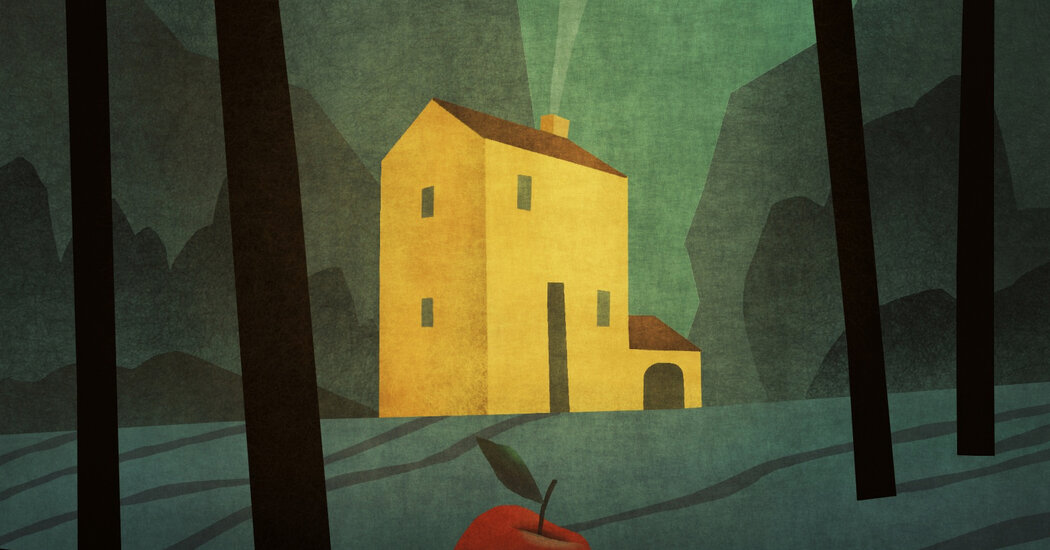
Mason hits notes of comedy as well. When a local medical practitioner ministers to the young Osgood, prescribing the inhaling of rancid sheep milk to cure his apple mania (Mason, himself a trained physician, knows the history of quackery), the boy observes that “it is not mad to think of fruit.” To which his brother responds: “Sniff, man.”
Across nearly 400 pages we get involved in each of these lives, then move on; the only abiding players in this drama of ineluctable transformation are Nature and Time. Mason maintains a naturalist’s focus on flora and fauna, on the dissolution of bodies and on biological processes as seasons yield to years and to centuries. In one whimsical passage, the erotic entanglement of a vacationing couple before a cabin fireplace in 1956 is juxtaposed with the “sex romps” of two scolytid beetles, described in hilarious detail — “What perfume! Threo-4-methyl-3-heptanol! Alpha-multistriatin!” Their larvae are lodged in the bark of the firewood that the couple bring with them, carrying a malignant spore that in time will kill all the chestnut trees around the yellow house.
From this profusion Mason draws narrative intricacies I can only nod at here. A Bible belonging to a Black family in Canada, a letter written by an anonymous Native American captive, a box of home movies, old bones surfacing in the mud of spring. Documents, artifacts and stories recur across centuries, creating dramatic ironies and invoking ghosts both metaphorical and literal. How to describe Mason’s sui generis fiction? Think of E.L. Doctorow crossed with Wendell Berry, then graced with a Nabokovian predilection for pattern, puzzle and echo.
The last ghost to haunt these enchanted woods — taking the story into the 21st century and peering forward — is a botanical researcher who notes the insignificance of individual human fates. “Indifference,” she reflects, “is what one might call the great lesson of the world.” And yet, the narrator continues, “she still expects a pause, some kind of recognition or acknowledgment.”
The secret of “North Woods,” its blending of the comic and the sublime, lies in the way Mason, deftly toggling between the macro and micro, manages to do both. He not only acknowledges cosmic indifference but celebrates it, even as he pauses to recognize the humans who experience jubilation and heartbreak as they wend their way toward oblivion.

