

FORTUNE’S FRENZY: A California Gold Rush Odyssey, by Eilene Lyon
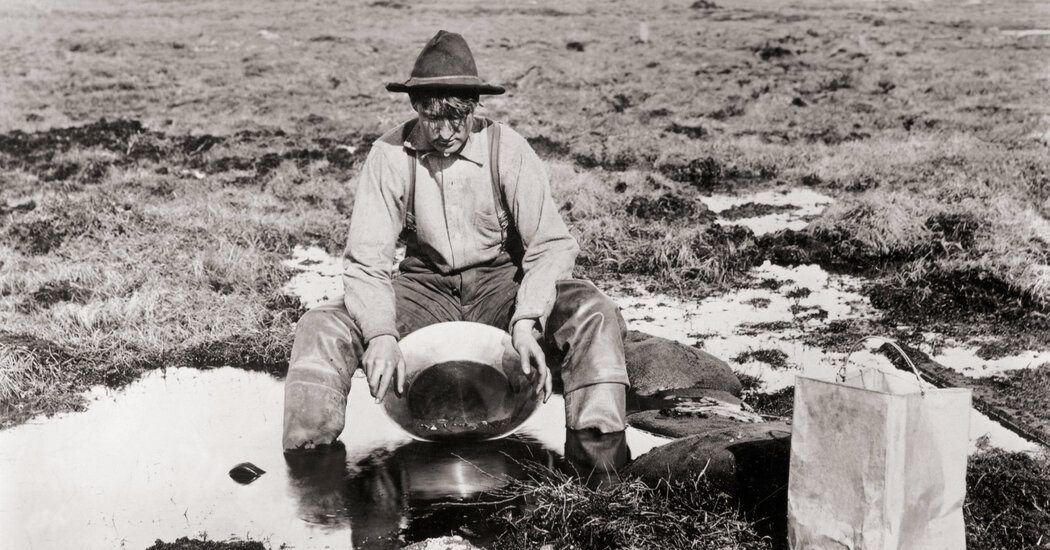
How do we remember the forty-niners? The hundreds of thousands of gold miners who flooded California, displaced Indigenous people, remade the landscape and laid the ground for statehood? Perhaps we picture a grizzled prospector panning for gold, broke and desperate, praying for the mother lode. Whatever we imagine, according to a new book by Eilene Lyon, the reality was much worse.
“Fortune’s Frenzy” traces the path of Henry Jenkins, an Indiana farmer who left for California in 1851. Like many miners, he took on crushing debt to finance the adventure, agreeing to an interest rate of 59 percent on the assumption that he would return a rich man. What followed were years of hardship and misery as Jenkins risked everything and gained nothing at all.
Jenkins was a Philadelphian who went west to make his fortune on the frontier and found himself less prosperous with every year. Lyon describes him as “a responsible, sober adult” whose belief in temperance and toil were no match for a dearth of hard currency and a surfeit of bad luck. His voyage to California was not a foolhardy gamble but a carefully planned attempt to regain his financial footing before his family starved.
He and his comrades traveled by sea, from New Orleans to Panama to San Francisco, enduring bad food, hellish accommodations and endless refrains of the grating earworm, “Oh! Susannah.” For Jenkins, who was reserved, the greatest irritants were his exuberant fellow passengers, whose godlessness, “swearing and merriment” made him long for his quiet home.
This irritation is preserved in letters to his wife, Abby, who stayed behind to supervise family and farm. Although it would be months before his letters reached her, he wrote faithfully. When he reached California and discovered that in the area he intended to prospect there were an estimated 80,000 miners — 10 times the 1850 population of Indianapolis — his letters took on the false cheer of someone ruined by a multilevel marketing scheme who is trying to convince themselves that success is just around the corner.
“One person at Carsons Hill is supposed to have got more out of his claim than Jacob Astor was worth at his death,” he wrote. “We don’t anticipate such a large pile but will be content with two thousand each by next spring, but with nothing less.”
After more than a year in the fields, Jenkins cut his losses, cobbling together enough to make it home. “Gold or no gold,” he wrote, he preferred “poverty with my family rather than separation.” He returned to Indiana and defaulted on his debt, beginning a yearslong court battle with the lender.
Lyon, a descendant of Jenkins, makes full use of her family archives, using the letters to put Abby’s struggles on the same level as her husband’s. Although she often quotes these missives in more detail than they merit — “There is but few apples in the orchard. The trees look well. Our oats in the meadow and along side the house look pretty well but our corn looks sorry” — what emerges is a detailed portrait of two ordinary people united by faith and family and love.
At times the book’s devotion to the Jenkins family tree makes it feel like a genealogy lecture, but some sections are thrilling. The best concern Henry’s son-in-law William Ransom, who did not let Henry’s lack of success deter him from following in his wake. On reaching Panama City, he found a monthslong wait list for steamship tickets, and so booked passage on the Emily, a poorly provisioned sailing ship whose captain had no knowledge of the route to San Francisco. A 40-day journey turned into a into a three-month nightmare. Food ran out, water grew scarce and fever spread; over a dozen passengers died. By the time he reached California, Ransom was a walking skeleton.
He rebounded quickly, becoming the only figure in the book to find success there, perhaps because he avoided the gold fields and instead found work growing food to feed the state’s exploding population. Lyon closes Ransom’s story with the tantalizing detail that he “eventually attended medical school and became a licensed doctor in Indiana. He committed bigamy at least twice and, in 1894, swindled the people of South Haven, Mich., and across the country, with a wild plan to sail a research vessel around the world.”
That the book’s most successful character eventually turned swindler is appropriate, for “Fortune’s Frenzy” recasts a pivotal American myth — that of rugged miners striking out to wrest their fortunes from the land — as a boondoggle, a con. It’s a reminder that since the country was founded, capitalism has been grinding people like Jenkins and Ransom into dust.
Once upon a time, the dust was gold.
W.M. Akers is a novelist, editor of the newsletter Strange Times, co-host of the film podcast I’ll Watch Anything and creator of the game Deadball: Baseball With Dice.
FORTUNE’S FRENZY: A California Gold Rush Odyssey | By Eilene Lyon | 307 pp. | TwoDot

