

OPINION:
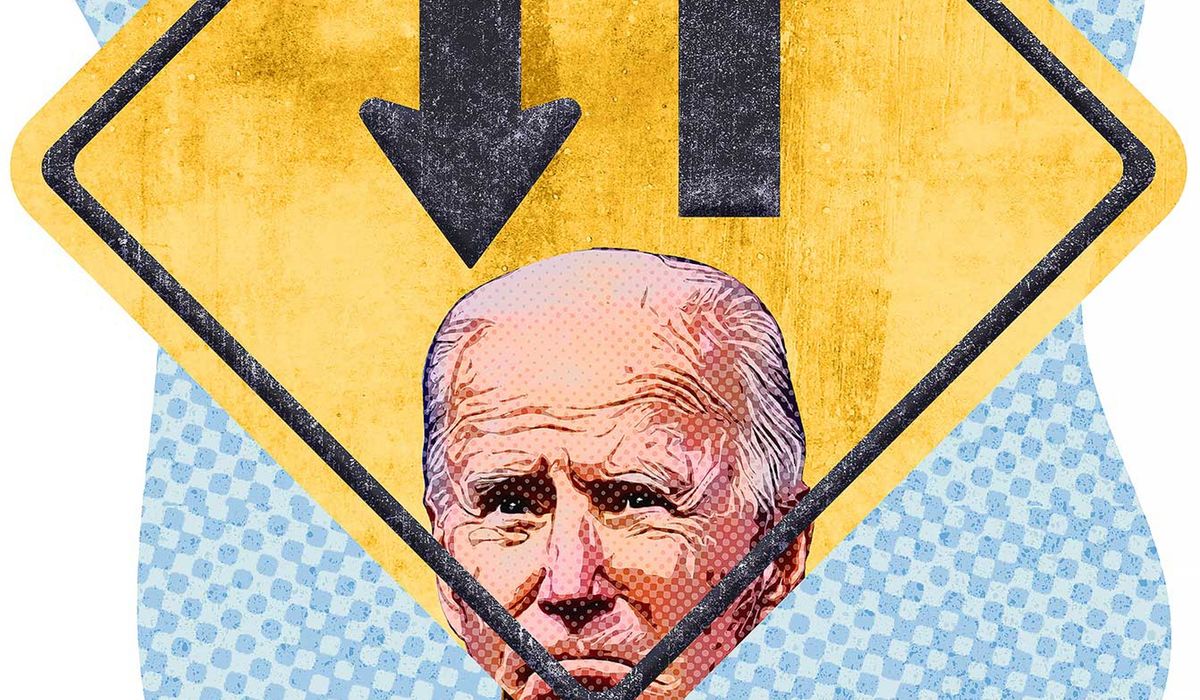
Millions of Americans believe President Biden’s economic policies have been terrible for their families’ finances. They are correct. Cutting through the administration’s fuzzy math and misuse of cherry-picked macroeconomic numbers — and focusing on personal finances — demonstrates how badly “Bidenomics” has failed Americans.
Mr. Biden’s most damaging failure is the runaway inflation caused by his administration’s profligate spending and his war on fossil fuels. According to the Bureau of Labor Statistics, cumulative inflation under Mr. Biden exceeds 17%.
This is the largest explosion of inflation in 40 years. Any wage earner who has not received a cumulative pay raise of over 17% in the last two years and 10 months has suffered a de facto pay cut.
Wages have not kept pace with inflation, so the buying power of Americans has suffered. Inflation is extremely regressive, hurting working-class people. It is a tax on everyone, including the poor. While many working-class Americans do not have a degree in economics, they know they are paying more for less.
Retirees and other savers whose investments or bank accounts have not achieved at least a 17% cumulative return have also lost ground. Inflation has effectively caused savers to lose money even where the nominal amount of their savings has not declined.
For example, a retiree who had $200,000 in a bank account or money market fund on Jan. 20, 2021, has seen the value of that $200,000 decrease by over $34,000 due to inflation under Mr. Biden (the loss softened only by whatever minimal interest the retiree earned). The retiree’s purchasing power has plummeted.
For those invested in the stock market — including those with personal and retirement funds — the story is also bleak. Over the last century, the stock market has increased in value by 10% on average per year — 7% per year when adjusted for inflation.
In recent decades, the average return has been even higher. Had the stock market achieved even the lower 10% annual growth under Mr. Biden, it would have shown a cumulative increase (after compounding) of 30%. Sadly, it has not.
The S&P 500 index was 4,568 on Nov. 30 (thanks in part to an 8.9% rebound in the S&P last month). When President Biden took office, the S&P 500 index was 3,798.
So the S&P 500 index price level is up just over 20% in the last two years and 10 months, but that increase is only two-thirds of what it would have been had the market met the average annual increase for the last 100 years.
And the news is worse than that.
The 20% Biden S&P 500 increase is barely enough to keep up with cumulative inflation. Rather than gain value at historical norms, the S&P 500 index under Mr. Biden has barely kept above water when adjusted for inflation.
Investors have been hurt, and cruelly, capital gains taxes eat up the largely illusory increase in stock market value for those needing to sell securities — for example, those needing to fund inflated retirement expenses.
One hundred thousand dollars invested in the S&P on Jan. 21, 2021, is nominally worth $120,000 now, but due to inflation, its purchasing power is only $103,000, and the $20,000 nominal gain is subject to capital gains tax. The de facto purchasing power is under $100,000, and the investor has lost ground.
As a result of these inflation shocks, the rates of interest on many financial instruments have increased. On the day Mr. Biden took office, 30-year fixed mortgage rates were just under 3%. The annual principal and interest costs for a $400,000 mortgage were approximately $20,000. Today, 30-year mortgage rates are 7.5%.
The annual principal and interest cost of a $400,000 mortgage is over $33,000. That means that after almost three years of Bidenomics, many homebuyers can afford only two-thirds of the house they could have bought before Mr. Biden became president.
That added cost may mean the difference between moving to a safer neighborhood with better schools — or not. Interest rates on credit cards and home equity loans — used by some to fund their children’s college education — have also soared.
Mr. Biden claims net worth has increased due to his policies. To the extent that some Americans’ net worth has increased, it is largely because the value of their homes has increased. But that purported increase is somewhat misleading. Unless the appreciated real estate is purely investment property, an increase in the value of one’s home (or even vacation home) does not improve a person’s financial standing.
If a homeowner wants to buy a better home — be it upsizing for a growing family, downsizing for empty nesters, or opting for a more luxurious or valuable home or one in a safer neighborhood — the price of such a better home is also increasing and getting out of reach. Since citizens cannot take their low-rate mortgages with them when they trade homes, they are stuck financing a new home at today’s inflated rates, trapping homeowners.
And no liquidity is generated by inflated home prices, unless one wishes to borrow against the home’s equity at today’s high interest rates. They are merely paper increases in net worth. Indeed, the only practical short-term impact of increased home value may be a higher property tax bill.
So if someone must or chooses to remain in their home, the increase in that home’s value is of no practical, tangible, near-term benefit to the owner. At the same time, the price of milk, eggs, fuel and services is increasing due to inflation not seen for 40 years. And such increases are not merely on paper. In short, Americans understand that they cannot eat the increased value of their homes.
The administration recently boasted Americans are better off because inflation “has fallen by 65% from its peak.” Inflation has fallen from Biden’s June 2022 40-year high of 9.1% to October’s less painful 3.7%.
A Nov. 27 White House fact sheet noted this so-called accomplishment in connection with what it described as the “Bidenomics agenda to lower costs for American families.” But reducing runaway inflation does not mean lowering prices; indeed, the general price level continues to increase, just at a slower rate.
That is, contrary to the president’s assertion, prices are not coming down; they are just rising at a lower rate than the worst level. The White House’s claim is like a failed dieter who has been binge-eating for the last two years, arguing that he has actually lost weight because he gained only 3.7 pounds last month.
Americans have suffered greatly under Bidenomics. To paraphrase Lewis Carroll, under President Biden, Americans “must run as fast as we can, just to stay in place. And if you wish to go anywhere, you must run twice as fast as that.”
No wonder Americans are not buying the White House’s happy talk.
• John Daukas is former acting assistant attorney general for civil rights in the Department of Justice under former Attorney General William Barr. He recently wrapped up a stint as chief counsel for civil issues on the Senate Judiciary Committee under Sen. Lindsey Graham.

